Chatbots for FAQ. Sales AI for quotes.
AI chatbot or a sales AI that quotes? A general AI chatbot answers from broad training, so it is good at FAQ, lead capture and drafting, and it will invent a plausible price for a custom product. Poly9 AI is a sales AI: it reads only your catalog, refuses options your rules forbid, prices from your recipes and grade matrices, and says price on request when a rule is missing.
General chatbots are strong at FAQ, lead qualification, drafting and research. Every rep has one open, and they are good at capturing a buyer’s contact before a quote is ready.
They do not know your catalog, cannot enforce compatibility rules, and when asked for a custom price they produce a number that looks right. You find out it was wrong when the order is short or the margin is gone.
Keep the chatbot for FAQ, lead capture and drafting. Choose Poly9 AI when the buyer is configuring a custom product and the price must come from your rules.
The five verbs, plus four that decide it.
Rows the other category wins stay in. Swipe the table on a phone.
| What matters | general AI chatbots | Poly9 AI |
|---|---|---|
| Answer | FAQ answers from general training. Good at shipping, returns and lead capture. | Product answers from your catalog: repeat, width, grade, fire rating, stock. Not for FAQ. |
| Configure | Describes options in words. No compatibility enforcement. | Shows the product in the chosen option from your materials library. Your rules refuse what does not fit. |
| Price | Invents a plausible number from patterns in its training data. | Prices from your recipes and matrices, or says price on request. Never estimates. |
| Quote | Drafts a quote-shaped email or captures the lead for later follow-up. | A traceable quote the buyer approves from the email. Every line shows its rule in Projects. |
| Present | Generates an image of something that resembles your product. | Renders your product in your materials, labeled, and prices a collection from a mood board. |
| Drafting and researchThey win this row | Emails, summaries, market and material research, in seconds, on anything. | Not the job. Poly9 AI stays inside your catalog and your rules. |
| Learns your business | Forgets the conversation. Trained on the world, not your company. | Remembers your buyers and quotes and learns which options each buyer asks for. Trains only on your company. |
| Pricing model | Free, or a monthly seat fee for team plans. | One credit per sales action, $100 buys a thousand, everyone on your team included. |
| Time to first quote | Instant, and wrong about custom pricing. | Same day with a sample catalog. Certified quotes once your first pricing rule is written. |
Category behavior is described in general terms; specific products vary. Poly9 AI behavior is as shipped in September 2026.
The same question, two paths: cited from your catalog and rules, or plausible with no source.
Why the differences matter.
A general chatbot answers from broad training. It is good at FAQ: shipping policy, return windows, lead times. It captures the buyer’s contact when they are not ready to configure. It knows nothing about product 3585-11’s vertical repeat or fire rating. Poly9 AI reads 25.5 inches from the fabric record and Class 1 from the compliance field, because the catalog is the only place it looks.
A chatbot describes walnut in words. Poly9 AI enforces compatibility: if your recipe says “walnut leg requires a wood frame”, it refuses walnut on the upholstered base and explains why. Then it shows your walnut, from your materials library at your price, on the product the buyer is looking at, labeled as a render.
This is the line that matters for custom products. Ask a chatbot “how much for this sofa in grade F with nailheads?” and it produces a number that looks like a price. Poly9 AI runs your grade matrix line by line, applies your nailhead upcharge from the recipe and returns the number your rules produce. When the nailhead rule is missing it says price on request and drafts the request for your pricing team. The eval suites that guard this pass at 100% on the error cases, every release.
A chatbot drafts an email that looks like a quote, or captures the lead for a rep to follow up. Both are useful until the drafted quote carries an invented price. Poly9 AI sends a quote the buyer opens from the email and approves in one tap, on their phone. Every line is traceable to its rule, and the approval is logged in Projects with a timestamp.
Image generators make a chair that resembles yours. Poly9 AI renders your chair, from your product photo, in your chosen materials, labeled with option codes. Send it a mood board and it builds a priced collection: nine pieces rendered, priced from your rules, one link the buyer can approve from.
Here the chatbot wins, and you should keep it. Drafting the follow-up email, summarising a call, researching a competitor’s fabric range or a new fire standard: a general chatbot does all of that in seconds and Poly9 AI does not try to. Poly9 AI stays inside your catalog and your rules on purpose, because that is what makes its prices right.
A chatbot starts every conversation from zero and trains on the world. Poly9 AI is scoped to your company. It remembers what Dana asked last Tuesday, learns that this buyer prefers grade F when the upcharge is small, and notices that nailheads usually go with box-pleat skirts in your quotes. The rules are still yours; the memory is new.
Chatbots are free or a monthly seat fee. Poly9 AI charges one credit per sales action, so the cost follows the quotes you send, not the logins. A showroom with fifteen people who together send twenty quotes a week pays for those actions. Everyone on your team is included on every plan.
A chatbot is instant. Poly9 AI is an account you create the same day: add your catalog or start with your industry’s sample catalog, write the first pricing rule in plain language, and send the first certified quote in the same session. A 37,400-SKU fabric catalog loaded in one day once the files were in hand.
- FAQ support: shipping, returns, lead times, care instructions, availability.
- Lead capture when a buyer is browsing but not ready to configure.
- Drafting emails and summaries that carry no product-specific price.
- Research about a market, a material or a competitor.
- Anything where a plausible answer is good enough and no quote follows.
- A buyer is configuring a custom product and needs a certified price.
- The answer has to be true of your product’s specs, not products in general.
- Compatibility rules must be enforced: refuse walnut on upholstered, require stainless for washdown.
- A price will reach a buyer, and the number must come from your rules.
- The buyer should configure on your site and approve the quote from their phone.
Most manufacturers keep a general chatbot on their site for FAQ and lead capture and hand the conversation to Poly9 AI when the buyer is ready to configure. The chatbot answers “do you ship to Canada?” and “what is your lead time?”. The sales AI answers “show me this sofa in grade F with brass nailheads” and returns the certified quote.
Ask for an option you have not priced.
Whatever you compare it with, run this on your own catalog. Poly9 AI prices from your recipes and matrices through one engine, and when the rule is missing it says “price on request” and drafts the request. The tool that produces a plausible number instead is the one that costs you an order.
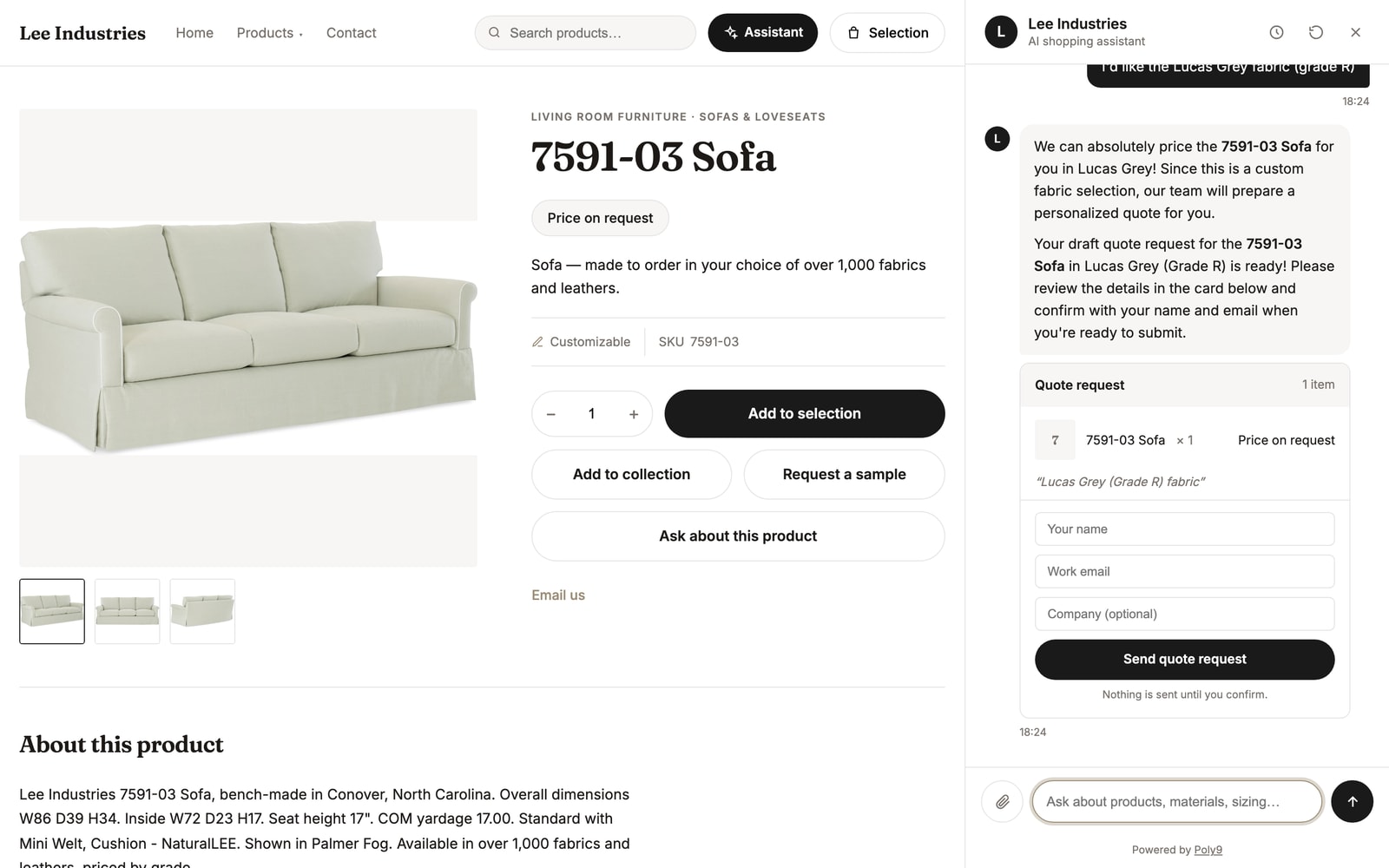
No rule for that fabric, so no number: a drafted request, price on request. Real storefront.
Questions about general AI chatbots.
Is Poly9 AI a chatbot?
What is “price on request” and why does it matter?
Can we use a chatbot for custom product sales instead?
Is Poly9 AI built on the same kind of models as general chatbots?
Does Poly9 AI hallucinate?
Can a chatbot read our price list if we upload it?
What does it cost compared with a chatbot subscription?
Why would we need both?
What if our products are not custom?
How fast can we test this?
- Poly9 AI eval suites, error-tag cases at 100%, September 2026
- Poly9 AI plan catalog and trial terms, September 2026
- Poly9 AI sample catalogs at signup, September 2026
Start free. Judge it on your own catalog.
Create your account, add your catalog or start with your industry’s sample catalog, and ask the question you would ask the other tool. 250 sales actions free, no card, and the account stays yours.